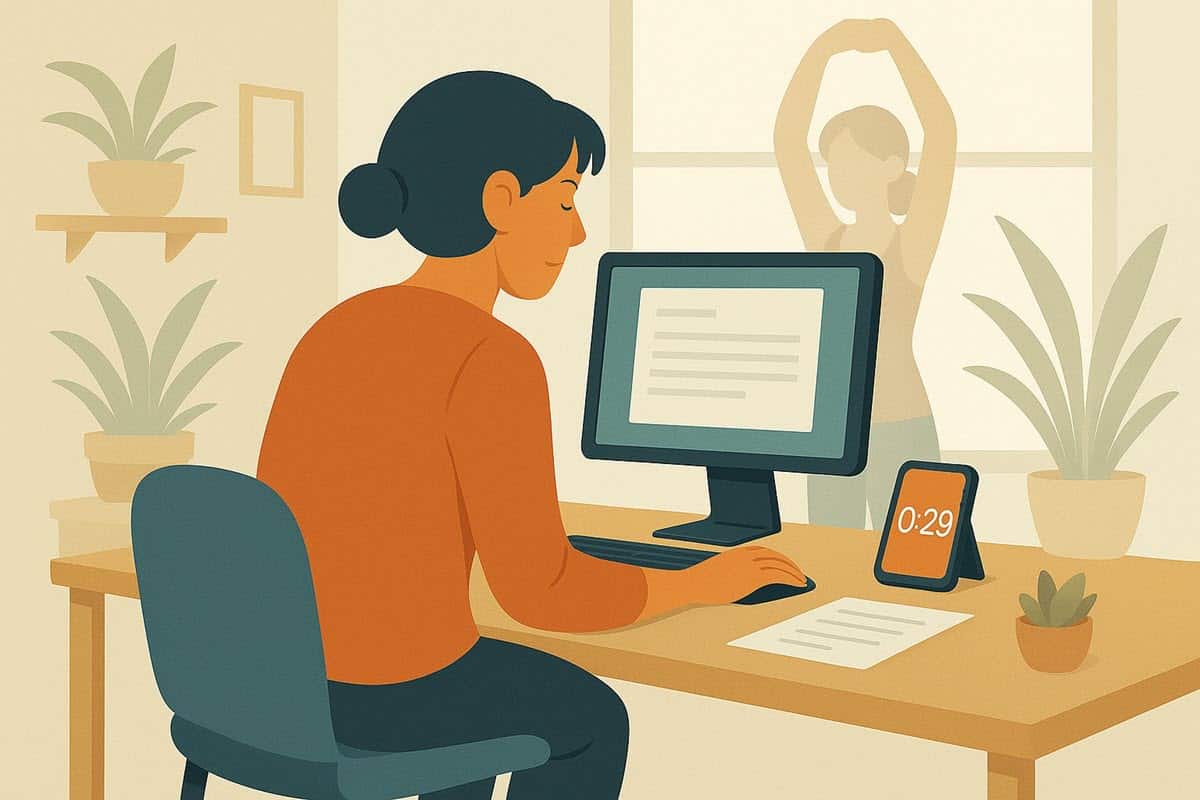
We’ve warned writers about the problem of prolonged sitting here and in Freelance Writer’s Report going back a decade and longer.
But now the TikTokers have joined the chorus by declaring war on “office chair butt.”
Which begs the question: Are these the same ailment? Or is the trending office chair butt yet another challenge facing freelancers, authors, and creators in general?
Same basic cause but separate diagnoses
While “sitting disease” emerged as a scientific term warning about prolonged sitting’s systemic health risks, “office chair butt” focuses specifically on the physical changes to gluteal muscles from extended sitting.
The Science Behind the Sitting Problem
Research is confirming what many of us already suspect: sitting for long periods is really bad for our health. The World Health Organization says nearly 2 million deaths each year are linked to a sedentary lifestyle, making it one of the biggest health risks worldwide. And it’s not just one problem – sitting too much is connected to 34 different chronic health issues.
Don’t think this is a problem only for older writers following decades of keyboard pounding. A 2024 study in PLOS One found that even young, active adults who sit for eight or more hours a day have higher cholesterol and BMI levels. And here’s the kicker: Current federal exercise guidelines aren’t enough to undo the harm caused by sitting that long. This challenges the idea that regular workouts can completely make up for too much sitting.
TikTok’s “Office Chair Butt” Phenomenon
While the medical community has focused on broader health risks, TikTok introduced its own angle in 2025 with “office chair butt.” This viral term specifically describes the physical changes to gluteal muscles from prolonged sitting: muscle atrophy and aesthetic changes that result in a flatter, less toned appearance.
Occupational therapist Michael Milicia explains: “A lack of conditioning in your gluteus maximus and surrounding tissue leads to weakness, making it build up fat tissue and appear flatter or saggy.”
The phenomenon gained traction when TikTok user Alexandra posted a warning video that collected over 7 million views. Content creators began sharing videos of desk exercises, with many declaring their intention to combat the condition proactively.
Medical professionals confirm the legitimacy behind the viral term. Evan Johnson, DPT, director of Och Spine Care Outpatient Physical Therapy at NewYork-Presbyterian, notes that prolonged sitting can result in muscle “losing tone and eventually shape,” leading to “a flat butt appearance or a very soft, fleshy butt if muscle is replaced with adipose tissue.”
Understanding the Relationship
While both terms address consequences of prolonged sitting, they represent different aspects of the same underlying issue rather than identical conditions. Sitting disease provides the comprehensive medical framework for understanding systemic health risks, while office chair butt focuses specifically on localized gluteal muscle changes.
Both conditions involve gluteal muscle deactivation; what medical professionals term “gluteal amnesia” or “dead butt syndrome.” However, office chair butt emphasizes the aesthetic and functional changes to the buttocks, while sitting disease encompasses broader cardiovascular, metabolic, and cognitive impacts throughout the body.
The overlap is significant: both result from prolonged sitting causing hip flexor tightness, weakened gluteal muscles, and poor posture. The key difference lies in scope; office chair butt represents one specific manifestation of the larger sitting disease problem.

The Creator’s Dilemma: Unique Health Challenges
Home-based writers and content creators face particularly acute risks from both conditions. Unlike traditional office workers who may have structured break times and workplace wellness programs, Writers and other creators who run their own businesses often work in isolation with irregular schedules and intense deadline pressures keeping them in their desk chairs.
Beyond the non-structured day with little built-in “movement” incentive, the typical writer/creator may be facing more dire sitting-related challenges. Research on remote workers revealed alarming statistics directly applicable to home-based writers:
- A 2021 study of 2,000 remote workers found that 60% reduced their mobility by over 50% since working from home.
- The average remote worker takes just 16 steps from bed to workstation, with one-third sitting in work chairs entire days and 63% only walking to bathrooms or kitchens.
Breaking the Sitting Cycle
As noted earlier, current research has shown that even high levels of physical activity cannot offset the harmful effects of sitting for extended periods.
So even if you’re starting your day with a routine of walking, stretching, or lifting weights … if you then sit at your desk for 3 to 4 hours straight in order to meet an afternoon deadline, that morning routine hasn’t eased the effects of sitting disease or of a saggy butt.
Caution: You do not want to stop any physical routine; it does help strengthen muscles, improve flexibility, and maintain our general fitness.
What you want to do is add to the exercise with regular interruptions to sitting time throughout the day.
The Mayo Clinic suggests you “start by simply taking a short break from sitting to standing every 30 minutes.
I know. It’s difficult to stop when you’re focused and “in a groove.” I’ve been trying to do this for months and still not seeing consistency. Too often I either work beyond the 30-minute alarm, or “forget” (Freudian inaction, perhaps?) To set it for the next 30-minute break.
Windows has an “Alarms & Clock” app (called simply Clock in Windows 11) that works well, especially when pinned to the taskbar. It’s likely that Mac has a similar app.
Recently, I’ve turned to a timer app on my phone to see if I might be more successful using it. It’s called MultiTimer – https://www.multitimer.net/ – and is available from both the App Store and Google Play. The basic version is free; the Pro version has more features.
Think of something to do for three or so minutes during that 30-minute stand-up break. Reward yourself with a few pages of your current pleasure read. Or double-up by doing a fitness routine.
I like to march in place for at least 30 high steps; it gets the blood flowing. Other options: Walk up and down the stairs a time or two. Walk into and around several rooms. You get the idea. It takes only a couple minutes.
♦ If the 30-minute routine simply does not work for you, at least try the routine suggested by some experts: standing or moving for 5–10 minutes every hour as a minimum.
♦ When you attend an online Zoom-type meeting or during phone calls, stand up or walk around a portion of the time.
♦ During your breaks, use hand weights to get the blood flowing in your arms … or do stretching routines targeting hip flexors and glutes.
Important: Simply standing up on regular breaks may help with butt flattening/sagging, but it is not likely to lower risks of sitting disease. As the Mayo Clinic cautions, “It is not clear whether standing, on its own is effective for lowering the risk of too much sitting. 
So the bottom line: While sitting disease established the scientific foundation for understanding sedentary behavior risks, office chair butt’s viral nature has prompted immediate behavioral changes among young professionals.
Maybe it will get our writing and creator community, regardless of age, off our butts and help avoid or delay some of those 34 chronic conditions.
 About Dana K Cassell
Speak Your Mind